
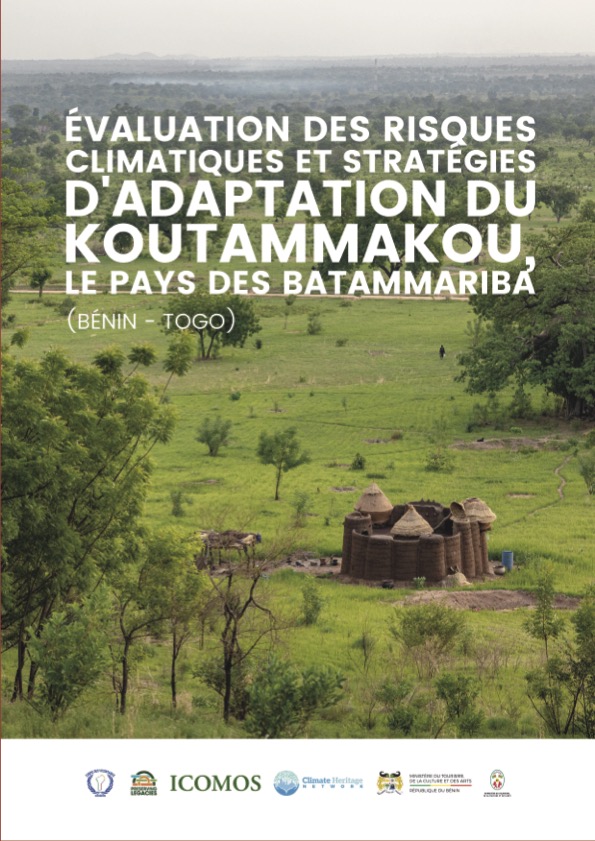
Évaluation des Risques Climatiques et Stratégies d’Adaptation du Koutammakou, le Pays des Batammariba (Bénin–Togo)
How to cite this publication
APA Style
Lossio Chávez, F. (2022). Tourism and Nation Branding: Trends and Digital Strategies: Art, Culture and New Technologies in Latin America and the Caribbean. https://doi.org/10.18235/0004301
Chicago Style
Lossio Chávez, F. (2022). Tourism and Nation Branding: Trends and Digital Strategies: Art, Culture and New Technologies in Latin America and the Caribbean. https://doi.org/10.18235/0004301

This locally led climate risk and adaptation assessment for Koutammakou, the Land of the Batammariba identifies six major climate hazards that are projected to intensify by 2080, assesses the four values prioritized by stakeholders — architectural, use, ecological, spiritual — to all be above the critical risk threshold, and proposes a biocultural resilience strategy for adaptation. Of note is its inclusive methodology that combined scientific data with a two-year long participatory process involving 277 local, institutional and international expert stakeholders.
Tchan Ibrahim, Batchatchilé Batanata, Toumoudagou N’Kierissima Joseph, N’Batchaka Tikpambiti



Corps des Volontaires Béninois, Ministere du Tourisme de la Culture et des Arts - Republique du Benin, Preserving Legacies, ICOMOS
Overview
Koutammakou, the Land of the Batammariba is inscribed on the UNESCO World Heritage List for its Outstanding Universal Value (OUV), grounded in the interdependence between the sikien (takienta), sacred spaces, cultural practices and the knowledge systems that structure Batammariba identity. The site cannot be analysed as a set of independent heritage elements: it constitutes an integrated biocultural system, in which material, immaterial, social and ecological components are closely interdependent.
“To me, Koutammakou is a living being," says climate custodian Casimir Batchatchile. "The climate risk assessment is its health checkup: it reveals its vulnerabilities, guides the necessary treatments, and allows us to take timely action to preserve its resilience and heritage for future generations.”
Methodology
The assessment drew on an integrated approach combining four complementary data sources: historical climate observations and climate projections from the IPSL-CM6A-LR (CMIP6) model, an inventory of heritage components, spatial analyses using geographic information systems and remote sensing, and a participatory process involving 277 local, institutional and international expert stakeholders.
The significance of this approach is underscored by custodian Casimir Batchatchile who shared, "What strikes me as particularly remarkable is the participatory approach taken in this assessment. The strong involvement of local communities—through their testimonies and observations—has helped corroborate the effects of climate change observed on the cultural landscape of Koutammakou. This local knowledge, when considered alongside scientific data and research, strengthens the credibility of the assessment and provides a solid foundation for identifying relevant adaptation measures that are grounded in both science and community knowledge."
Key climate findings
- Observed warming (1979–2025): +1 to +1.5 °C, accompanied by a decrease in average rainfall and strong interannual variability (coefficient of variation of 94.5 to 101.7 %)
- Projections to 2080: +2.5 to +3 °C under the SSP2-4.5 scenario; +4.5 to +5 °C under the SSP5-8.5 scenario, with maximum temperatures potentially reaching 37.8 to 42.9 °C.
- Intensification of rainfall extremes: +130 to +230 mm/year, with increased variability and irregularity of the hydrological regime.
- Six major climate hazards identified: extreme rainfall, prolonged droughts, violent winds, heatwaves, hydrological variability and rainfall irregularity.
Most exposed heritage components
The sikien (takienta) — traditional raw-earth dwellings — concentrate most of the exposure: they are often located in topographically unstable areas, amplifying their exposure to torrential rains (perceived as a threat by respondents) and drought. Sacred spaces (groves, springs, shrines), indigenous knowledge for intergenerational transmission, and traditional agrarian systems are also highly exposed.
Main risks and consequences
The analysis reveals an overall critical level of climate risk, particularly under the SSP5-8.5 scenario, across all heritage values of Koutammakou: critical risk for architectural value and ecological value, very high to critical risk for spiritual and cultural value, and high risk for use value. Without adequate adaptation measures, these trends could progressively and, in some cases irreversibly, compromise by 2080 the heritage values that underpin the resilience of the cultural landscape.
Action priorities
The source report proposes a transformative biocultural resilience strategy, structured around six action levers (resilience of vernacular building fabric, safeguarding of intangible heritage, ecological, restoration, socio-economic resilience, adaptive climate governance, and mobilisation of art and storytelling), and three cross-cutting priorities: governance, financing and community governance.
[Excerpts from the English-language strategic synthesis "Koutammakou Facing Climate Change" and testimonial from co-author Casimir Batchatchile]
Continue reading
%20cover.png)