
How to cite this publication
APA Style
Ginevra Boatto, Chou Radina, Phoeung Dara, Ly Phally, Hin Chandara, William Megarry, Victoria Herrmann. (2026). Climate Risk and Resilience in Angkor. APSARA National Authority, Preserving Legacies, ICOMOS, World Monuments Fund, and Climate Heritage Network. https://www.heritageadapts.org/risk-assessments/angkor
Chicago Style
Ginevra Boatto, Chou Radina, Phoeung Dara, Ly Phally, Hin Chandara, William Megarry, and Victoria Herrmann. Climate Risk and Resilience in Angkor. APSARA National Authority, Preserving Legacies, ICOMOS, World Monuments Fund, and Climate Heritage Network, 2026. https://www.heritageadapts.org/risk-assessments/angkor.

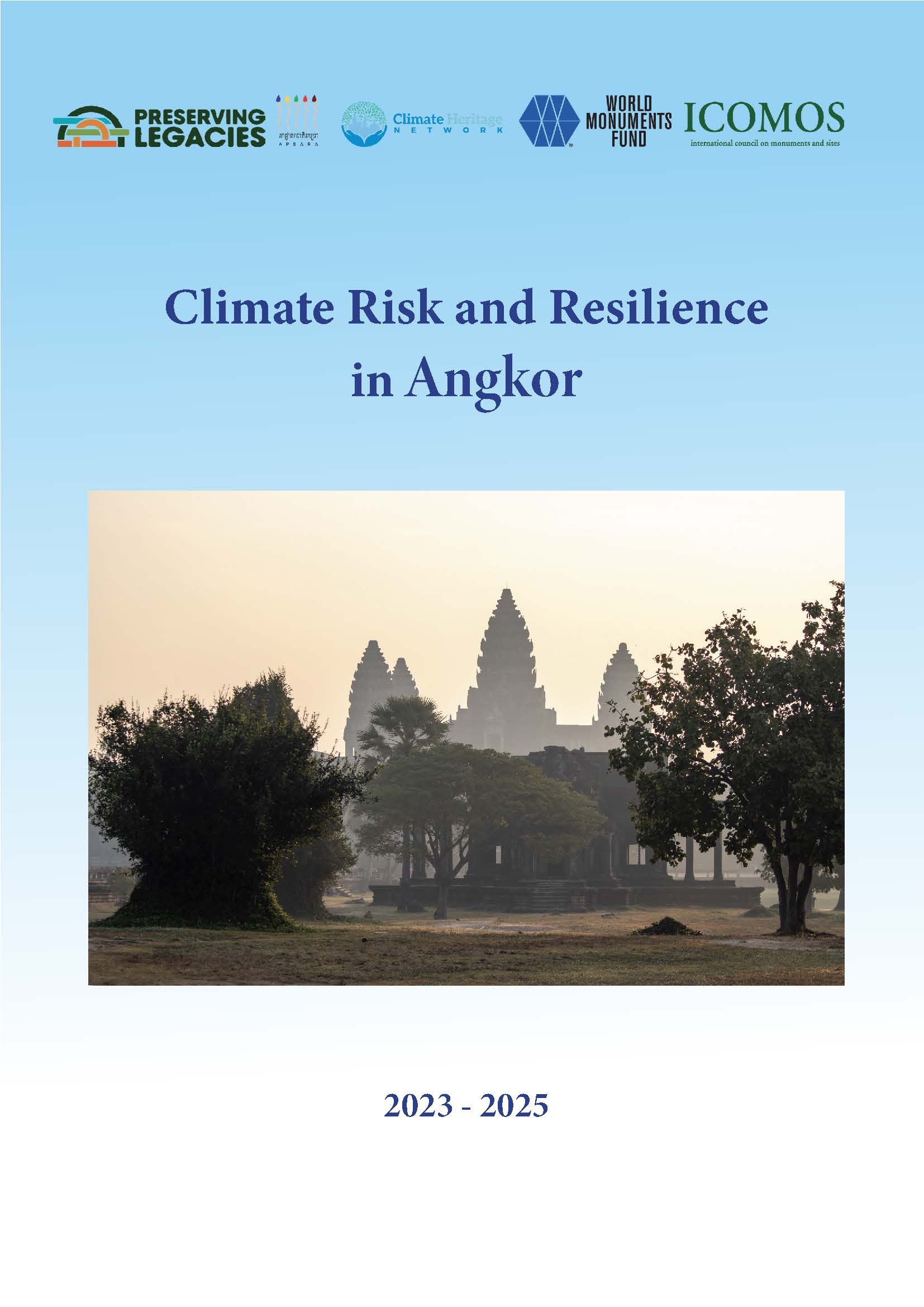
This first-ever locally led climate risk assessment for Angkor takes a values-based, community-led approach, recognizing the site as a living cultural landscape where heritage, nature, and local communities are closely interconnected. Driven by site custodians from the APSARA National Authority, the report draws on both scientific climate projections and community consultation to project a future in 2060 that is markedly warmer and wetter. Hazards like erratic rainfall and rising temperatures pose heightened risk to its UNESCO inscribed values, as well as new values uncovered through this engagement process, including natural, economic, and community health. Fortunately, existing conservation, water management, and protection by forests with two million replanted trees buffer these risks, resulting in an overall moderate level of risk.
Ginevra Boatto, Chou Radina, Phoeung Dara, Ly Phally, Hin Chandara, William Megarry, Victoria Herrmann


APSARA National Authority, Preserving Legacies, ICOMOS, World Monuments Fund, Climate Heritage Network
Details
Climate change has become one of the greatest challenges facing World Heritage Sites worldwide. Angkor is no exception. The increasing frequency of extreme weather events, changing rainfall patterns, rising temperatures, prolonged droughts, and flooding are already affecting both the cultural and natural values of this extraordinary landscape. This report is the result of a two-year collaborative effort between the APSARA National Authority, Preserving Legacies, World Monuments Fund, ICOMOS, and the Climate Heritage Network. More importantly, it represents the first locally led climate risk assessment for Angkor Archaeological Park, developed through the leadership of Cambodian professionals together with local communities, government institutions, researchers, and international experts.
The report is organized into several major sections:
Understanding Angkor
The report begins by introducing Angkor as one of the world’s most important cultural landscapes, highlighting its Outstanding Universal Value, its rich archaeological heritage, remarkable hydraulic engineering system, biodiversity, and the communities who continue to live and practise their traditions within the site.
Identifying Stakeholders
The report recognises that protecting Angkor requires the participation of many groups. Through focus group discussions, stakeholders including local communities, monks, APSARA National Authority, government agencies, conservation teams, researchers, tourism operators, schools, NGOs, and international organisations contributed their knowledge and perspectives to the assessment. This inclusive process ensured that climate adaptation reflects local priorities and community values.
Identifying Angkor’s Values
One of the most important achievements of this project was identifying the values that people consider most important. The assessment identified three principal values:
Historical, cultural, and spiritual values
Natural and environmental values
Knowledge, education, architecture, and scientific values
These values became the foundation for assessing climate risks and developing adaptation strategies.
Key Findings
The report highlights several important findings.
First, climate change is already affecting Angkor through increasing temperatures, irregular rainfall, flooding, drought, and environmental degradation.
Second, these changes threaten not only monuments but also forests, biodiversity, water resources, agriculture, tourism, traditional livelihoods, and the living cultural practices associated with Angkor.
Third, the report demonstrates that climate risk is not only a conservation issue but also a social, environmental, and economic challenge that requires integrated management.
Finally, the assessment shows that Angkor possesses significant strengths, including strong institutional capacity, extensive conservation experience, active community participation, and valuable traditional knowledge that can support future adaptation.
Key Recommendations
Based on the assessment, the report proposes several priority actions.
These include:
Strengthening climate literacy and public awareness;
Improving monitoring of monuments, forests, and water systems;
Expanding scientific research on climate impacts to stone and archaeological materials;
Integrating climate adaptation into conservation planning;
Improving water management and reservoir monitoring;
Reducing greenhouse gas emissions within the park;
Strengthening collaboration among government institutions, researchers, local communities, and international partners.
These recommendations provide practical guidance for future management and policy development.
Why is this report important?
Beyond documenting climate risks, this report establishes a new approach to heritage management in Cambodia. It demonstrates that successful climate adaptation depends on combining scientific research with local knowledge and community participation.
It also provides a foundation for developing future climate adaptation plans that will strengthen the resilience of Angkor while protecting its Outstanding Universal Value and the wellbeing of the communities who depend upon it.
Perhaps most importantly, this report shows that climate resilience is a shared responsibility. No single institution can address these challenges alone. Longterm success depends upon continued collaboration among government agencies, local communities, researchers, international partners, and civil society.
%20cover.png)