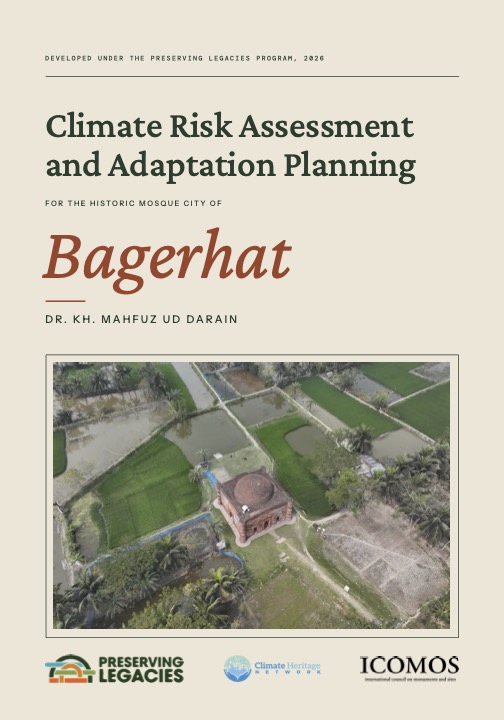
Climate Risk Assessment and Adaptation Planning For the Historic Mosque City of Bagerhat
How to cite this publication
APA Style
Darain, K.M.U. (2026). Climate Risk Assessment and Adaptation Planning for the Historic Mosque City of Bagerhat. Paris: ICOMOS.
Chicago Style

This locally led climate risk and adaptation assessment for the Historic Mosque City of Bagerhat establishes what people value, identifies the attributes that sustain those values, examines how climate hazards interact with exposure, vulnerability and responses, and connects the findings to proposed action. It focuses on six monuments and brings the property’s Outstanding Universal Value into conversation with locally held religious, social, economic and environmental values. It reveals that salinity affects, and is projected to increasingly affect, all six monuments, while flooding, heat, and other hazards have, and are projected to have, different consequences at each site. The findings inform site-specific proposals for structural safety, drainage, compatible materials, water-system restoration, and community preparedness, which will be further assessed and a plan implemented.
Dr . Kh. Mahfuz ud Darain


Preserving Legacies, ICOMOS, Climate Heritage Network, Architecture Discipline at Khulna University, Bangladesh's Department of Archaeology
Methodology
As part of the Preserving Legacies cohort program, two heritage custodians from the Historic Mosque City of Bagerhat conducted a participatory, values-based climate risk assessment to better understand how climate change impacts the site so that they can implement effective adaptation solutions.
"This is a values-based Climate Risk Assessment, which means it starts from what people at Bagerhat actually care about protecting, not only from what a materials scientist would measure," shared custodian and author Dr. Kh. Mahfuz ud Darain.
From February to May 2025, they engaged local stakeholders and rights holders—including mosque caretakers, imams, residents, traders, elders, children, heritage institutions and researchers—through a series of climate risk assessment engagements.
"Evidence behind this report comes from two rounds of focus group discussions, a physical survey of the site paired with interviews, children's painting workshops used to surface how the youngest residents see the changes around them, and a three-day workshop in May 2025 that brought together community members, heritage professionals, and researchers to rate what matters, rank what threatens it, and separate genuine adaptation from good intentions that made things worse," shared Mahfuz.
It follows the international risk framework built by the IPCC—hazard, exposure, vulnerability, and adaptive response—and adapted through Preserving Legacies' values-based, inclusive, and plural knowledge approach. In this assessment, Mahfuz shared that "three kinds of knowledge carry equal weight throughout: what climate science and instruments show; what residents, traders, and caretakers know from living there; and what the site's own centuries-old construction and water-management traditions already encode."
Lastly, six monuments were assessed individually: Shait-Gumbad, Chunakhola, Bibi Begni, Nine-Domed, the Mausoleum of Khan Jahan and Ranvijoypur. This approach revealed how risks differ within the same World Heritage property.
Key Takeaways
The assessment identified several interacting hazards, including:
- Salinity, which affects all six assessed monuments
- Flooding and waterlogging, which disrupts acess, damages structures, and interrupt reiligous practices.
- Heat and humidity, which increases pressure on buildings and community activities.
- Cyclones and changing rainfall, which adds further stress to the historic structures and surrounding landscape.
Four challenges that the report identifies and explors as particularly important to Bagerhat include:
- Salt. Bagerhat's brick and lime mortar decay when saline water moves through them and crystallizes as it dries, and some of the very repairs meant to stop this have made it worse.
- Geography. Bagerhat sits low in the tidal, shifting delta the Ganges and Brahmaputra have built over thousands of years, and sea levels near it are measurably rising.
- Slow erosion of the site's living character. A mosque that floods every monsoon is a mosque where worship is interrupted, again and again, until interruption becomes the norm. A gathering that grows more dangerous as summers get hotter is a tradition under quiet pressure. There is, at present, no formal system for managing crowds or guiding visitors anywhere on the site, an absence this report treats as a real vulnerability, not a footnote.
- Institutional. Bagerhat's custodians know how to conserve a wall. They do not yet have a management plan, a protected buffer zone, or a standing mechanism to coordinate the Department of Archaeology, local government, and the community that keeps the site alive day to day.
As Mahfuz shared, "Bagerhat is not threatened by a single dramatic event. The risk is slower and more structural: salinity stress on brick and mortar, the impact of cyclones and waterlogging on heritage places, and a policy framework that was never built with heritage in mind."
He continued, "That last point became the most significant finding of this assessment. We reviewed several of Bangladesh's national climate and disaster instruments, and none of them list cultural heritage as a sector — a gap that puts sites like Bagerhat outside the planning and funding structures meant to protect vulnerable assets.
This assessment set out to close part of that gap: to translate climate science, using the IPCC's own risk pathways, into a form that heritage managers and donors can act on. The value of the exercise was not only technical. It forced a rethink of how a fifteenth-century mosque city fits into twenty-first century climate governance, and what has to change — in law, in funding, and in institutional attention — for the answer to be "it does."
If this work has one message for other custodians and policymakers, it is that heritage risk assessment cannot stay a technical or academic exercise. It has to become a policy instrument. Bagerhat is one site. The gap we found is structural, and it likely applies well beyond Bangladesh."
Case Study: The tale of two adaptation actions
At the Mausoleum of Khan Jahan, a layer of white cement, applied years ago to stop a wall from decaying, has instead sealed moisture inside the brick and made the decay worse. This is the report's one confirmed case of climate-related maladaptation.
On the other hand, at Bibi Begni Mosque, two promising low-cost, traditional adaptation actions have been implemented and are recommended to document and test:
- A participant described a layer of lime mixed with honey applied about 30 cm (1 ft) below the plinth to protect the building from salinity. This is a documented local technique, but no participant reported an observed effect. A related technique, lime-sugar-based additives, is being recovered and actively applied in professional DOA conservation practice, so it is not an isolated folk claim. Experimental work supports the salinity resistance mechanism of closely related sugar-based additives in air lime mortar (Sharanya et al., 2025)
- An internal pond that, two participants state, absorbs excess water and helps remove dampness. This is the only response with a reported effect.
These are the assessment's most promising candidates for risk reduction. Both are low-cost, locally grounded measures that a purely technical conservation plan might never have thought to preserve. It is recommended to document and test these measures as a next step.
Next Steps
The custodians who led this assessment as part of their participation in the Preserving Legacies cohort program will continue to the next phase of implementing an adaptation action. This may include action items proposed in the report such as a structural assessment at Nine-Domed, flood protection at Chunakhola, materials testing at the Mausoleum, drainage and lightning protection at Shait-Gumbad, and documentation of Bibi Begni’s traditional techniques. Restoration of historic reservoirs, community hazard-response training, a site management plan and stronger buffer-zone protection addressed risks across the wider landscape.
Continue reading