
How “Loteria”, a local Bingo game, facilitated climate change conversations in Cartagena, Colombia
-880.jpg)
Hear from Dr. Salma Sabour
When engagement sessions with community members around climate change stalled, Preserving Legacies custodians paid attention to local cultural traditions, got creative, and put a climate change spin on a local game to more equitably connect.
Getting to know Tierra Bomba beyond its fortified facade
It’s hard to remember a time where we, Gabriela Caro Leon and Carlos del Cairo Hurtado, were not familiar with the islands and communities on the coast of Cartagena de Indias.
Tierra Bomba island, in the Colombian Caribbean, is only 15 minutes away by boat from the city of Cartagena but is often misunderstood.
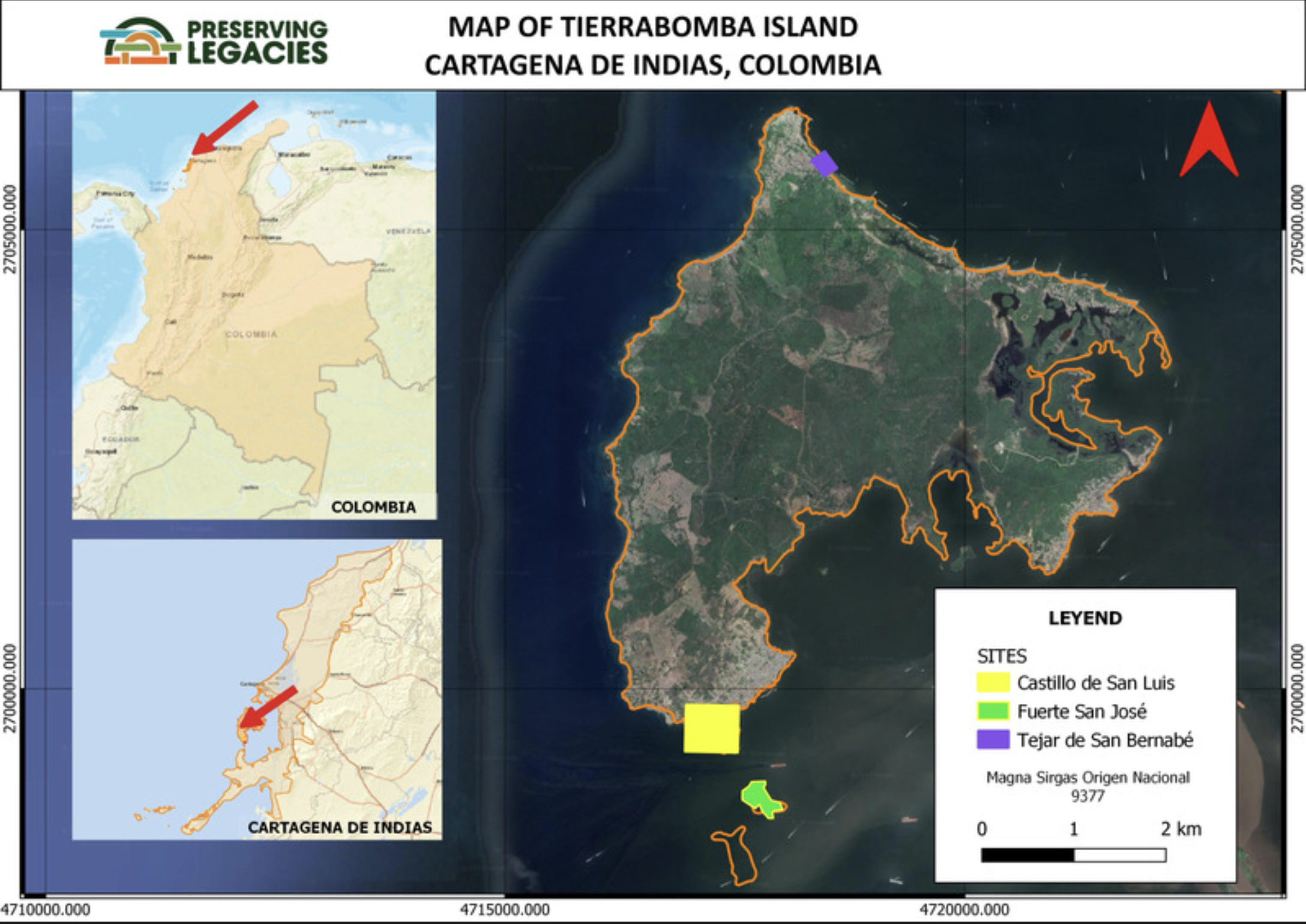
Heritage Sites on Tierra Bomba Island, evaluated within the framework of the Preserving Legacies project (Carlos del Cairo & Gabriela Caro, 2023)
The island is mostly known for its beach clubs and 18th century colonial forts, which defended the city from pirate and enemy attacks by forcing ships to enter the city through the channel and then bombarding them from both sides. It is divided into four rural districts: Tierra Bomba, Punta Arena, Caño del Oro, and Bocachica. The latter contains important historical constructions of great cultural relevance, representative of the cultural diversity that originated in the fifteenth century and that remain closely linked to maritime cultural heritage.
Like Cartagena and its other surrounding islands, it is affected by sea level rise and flooding.
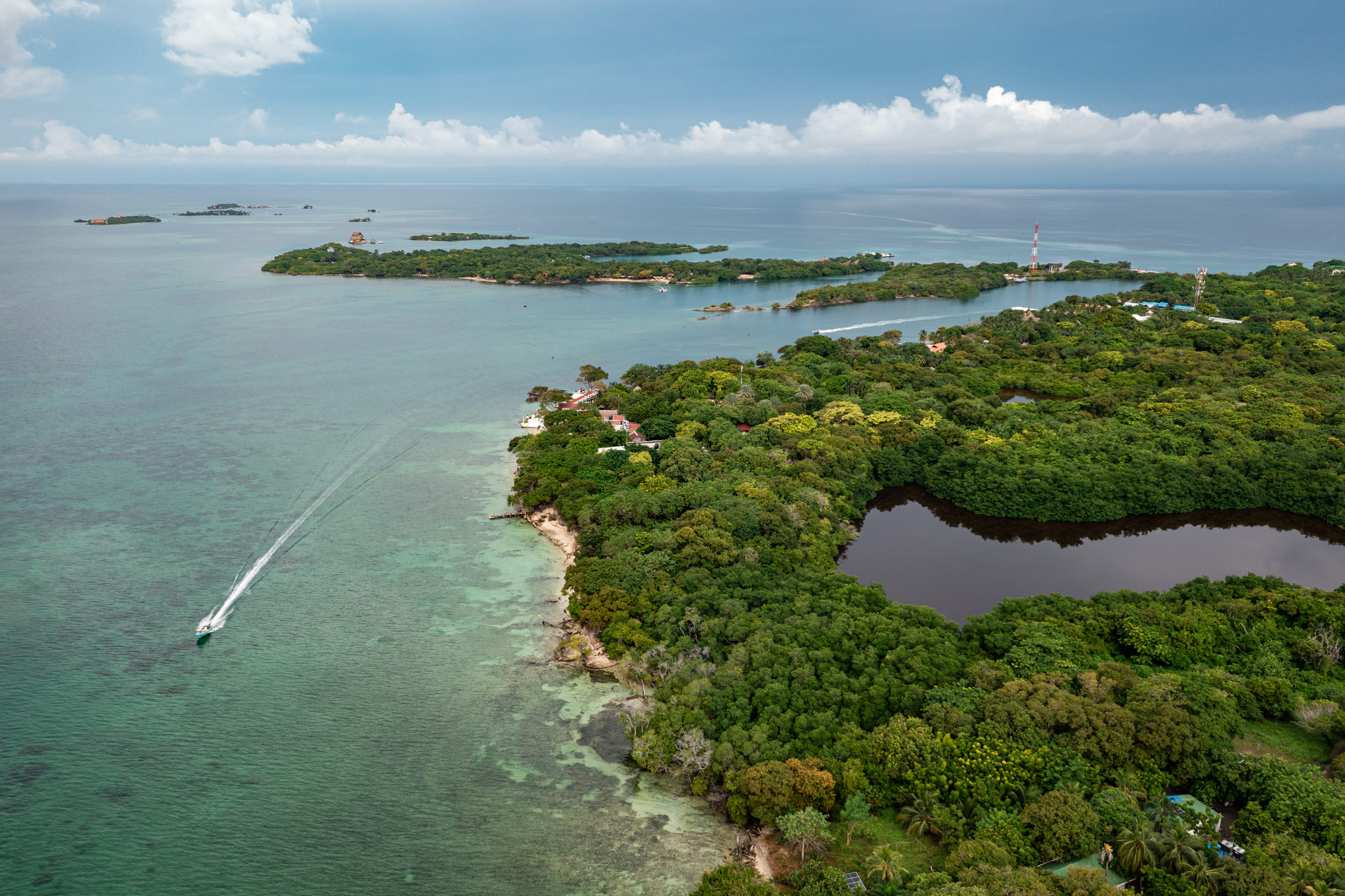
Being two researchers from Bogota, the landlocked capital city, that’s pretty much all we knew about Tierra Bomba. However, our perceptions quickly changed as we began to meet with locals and discuss climate change impacts and adaptation as part of our work with Preserving Legacies.
Centering local knowledge
Studies on the protection of Cartagena de Indias’ heritage against climate change have focused mainly on tangible heritage, such as these colonial-era historical sites. Until recently, the past and memory of the enslaved Black population and their cultural traditions have been mostly overlooked, particularly in island communities like Tierra Bomba.
.png)
This was a significant gap that we wanted to overcome in our own work to facilitate locally led climate adaptation. To efficiently and ethically adapt any place to climate change, we cannot rely only on scientific knowledge, we must weave scientific and local knowledge together. So, we headed to Tierra Bomba in September 2023 to learn how the communities identified, felt, and lived through climate change.
We had what we thought was a solid plan: in close collaboration with representatives of the island, we conducted several meetings in strategic places including the homes of community leaders, historic and touristic sites, and everyday places like beaches and restaurants in the main city of Bocachica where locals usually work and meet. The goal of these meetings was to facilitate a dialogue with the local community about the different values surrounding the maritime cultural heritage of Cartagena de Indias and the most common threats it faces in relation to climate change.
To achieve this, we used tools like maps and ‘Circles of emotions’ so participants could identify places on the island they considered most significant and the feelings associated with each of those places - from deep sadness caused by loss and deterioration to anger fueled by neglect and the fear of social and environmental degradation.
.png)
While these first meetings felt pretty successful, we soon found that work responsibilities, combined with the hot and wet climate, made it difficult for people to actively participate in the activities. We also felt that they were distant with us. How could we better suit the needs of the community?
Bingo!
One day, while we were facilitating a workshop near the beach of Bocachica, something made us pause. More than twenty people, men and women of all ages, were laughing and engrossed in a popular game known as loteria (bingo).
Under that wooden kiosk - a traditional open wooden structure, with a palm roof that allows natural ventilation and shade - the atmosphere was joyful despite the heat and humidity. The players were just themselves, in a space that felt comfortable and familiar.
.png)
That’s when we realized: if we wanted to truly connect, we had to speak their language, and not assume they'd connect with ours.
A game changer for climate conversation
We had our answer and we immediately turned to the community leaders to redesign our workshop into a climate change Lotería, or Bingo game.
The game is best described by Donayro Guzman who in a 2023 interview said,
“The game has a deck of cards and small boards with images or numbers on them. Then one person takes out the cards one by one, calls them out loud for everyone to hear, and whoever has that card on his board, marks it. The one who manages to fill the board first or the figure that is being played, shouts LOTERIA!, that is the one who wins."
Using the information provided by the community from earlier sessions, we got to work at creating our climate change version of this popular game. We created eight boards and forty-eight lotería cards. Each board had two sides.
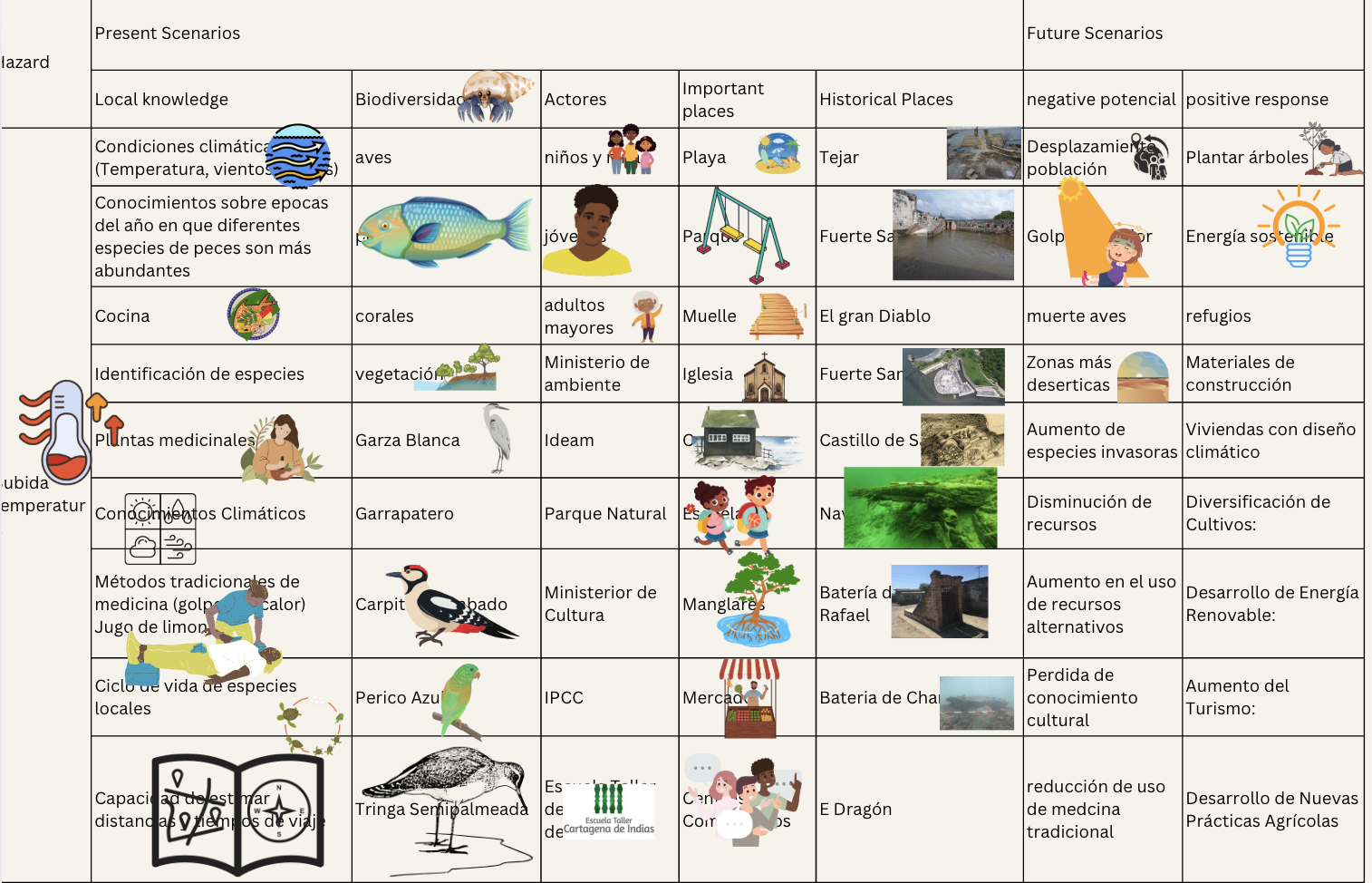
The first side was organized in three sections. The left one, called the “present scenario,” included attributes organized in 5 thematic columns: local knowledge, community places, biodiversity, key actors, and historic sites. These included for instance the knowledge of medicinal plants and weather patterns, the beach, mangroves and corrals, ministries and youth, and the San Fernando fort.
The middle section depicted climate threats, and the right section, called the “future scenario,” showed examples of negative impacts and positive actions being implemented.
On the reverse side, we printed climate data from our team’s research—rising sea levels, temperature trends—so local knowledge and science literally sat back‑to‑back.
.png)
In the deck of cards, we also included question marks so that, when one of these cards would come up, we’d ask spontaneous questions, adapted to the situation and flow of the conversation.
Now, it was time to try it out!
“¡Lotería, claro!”
One Saturday at 11 a.m., we took a boat to Tierra Bomba with two of our co-researchers, Lilia Herrera and Donayro Guzmán. Ten community representatives were waiting for us around a wooden table, under a kiosk by the sea. We spread out the boards and playing cards on the table and asked the first question: “¿Qué creen que vamos a hacer?” (What do you think we are going to do?). They smiled and answered without hesitation: “¡Lotería, claro!” ("Bingo, of course!”)
Their faces lit up as they took each of the boards in their hands. It was the first time we experienced such a spontaneous reaction during a workshop. We hadn’t thought of bringing tokens to mark the boards, so they started to pick up stones and shells from the ground. It gave our game a unique and authentic touch.
Soon, we were no longer the external facilitators: they were the ones teaching us and leading the workshops. They explained the rules and guided the pace of the game themselves - “Tú saca la ficha y la cantas” (“You draw the card and call it out”), “el que la tenga la marca” (“whoever has it marks it”). They also spoke more naturally, no longer using a formal tone with us.
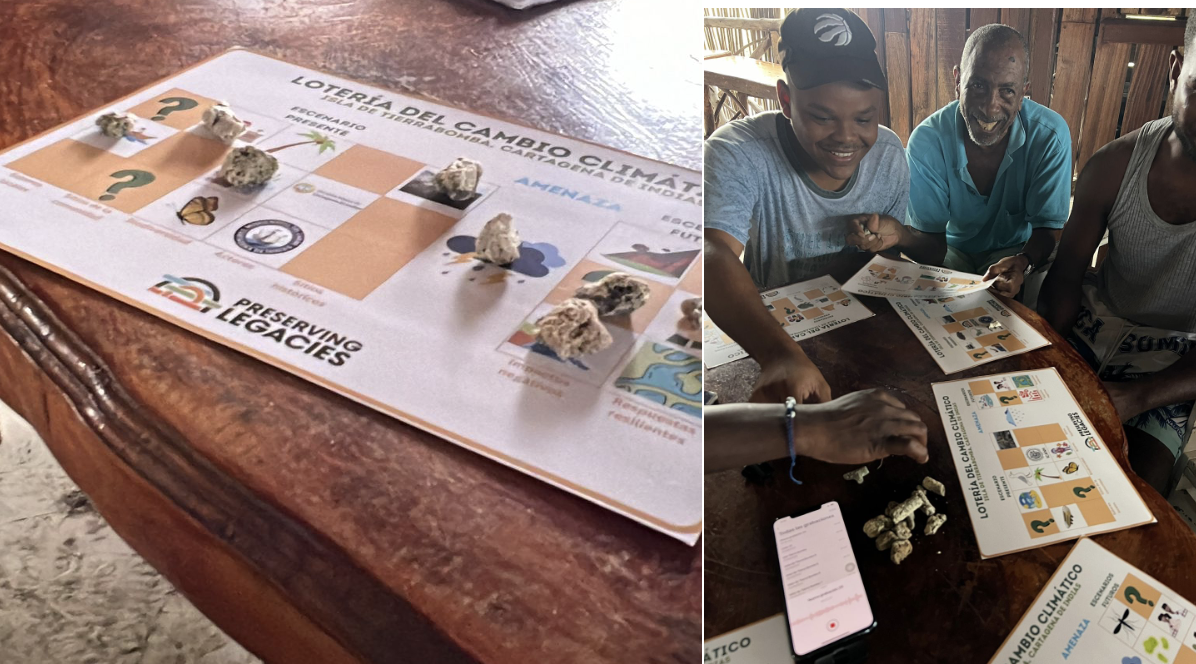
As the game unfolded, new comments emerged: how the new climate conditions - winds, rainy seasons, droughts - were changing fishing practices and deterring new generations to pick up the trade. We heard frustration caused by poor waste management and inadequate land-use planning, and fear from the impacts of rising sea levels that are reaching ever closer to the community houses.
This casual and familiar setting also allowed people to talk freely about social vulnerabilities: lack of job opportunities, absence of government support, and lack of cooperation among community members. We understood that these were the most pressing issues in their daily lives.
Later on, when we asked Lilia to reflect on this experience, her feedback reinforced our impression, confirming that we made the right choice:
“It’s a game that reminds us of our families; it was taught to us specifically by our grandmothers or our mums.[...] So I felt really good, really relaxed, and at home; I never felt like it was a stiff moment where we were just going to learn about climate change or something that could end up being quite a dense, difficult topic to get to grips with for those who don’t have much knowledge of the subject. [...] One of the things that really struck me during the game was how each person, through their own way of living in and interpreting the territory, ends up understanding the knowledge or the impacts of climate change on their heritage in very different ways.”
-587.jpg)
Conclusion and lessons learned
From then on, we became much more familiar with the island and its community. We not only learned a lot from each other, but we also shared laughs and shed tears together.
By challenging our usual methods and trying to break down the traditional academic hierarchy, we were reminded that those involved in the research should not be considered as objects of study but as co-producers of knowledge. For this to happen, we need flexibility, and methodologies that are diverse, interdisciplinary, and community-based.
The game proved to be just what we needed to find a shared language, making it the first step to ensure that the climate adaptation planning for Cartagena and its islands won't be another top-down formula coming from a faraway office– instead, it will be co-constructed and grounded in the reality of its inhabitants.
-599(1).jpg)


Délie Ronsin-Quéchon is the Knowledge Sharing Manager of Preserving Legacies. She leads the creation and continuous development of a robust knowledge base on climate change and cultural heritage, and the dissemination of this knowledge through the Preserving Legacies project and the Heritage Adapts! Community of Action. Prior to this, she has worked on several projects at the ICOMOS International Secretariat. Her past experiences also include coordinating national and international projects linking Cultural Rights, Climate Action, Territorial Cooperation and Social Economy within a network of cultural associations.